

A floating board-to-board connector is a mechanical structure used to connect two or more surfaces to each other. This connector usually consists of two or more metal plates, each of which has holes and raised parts to make contact with the other.
When objects that need to be connected have different geometry shapes, floating board-to-board connectors can provide a flexible and reliable solution. By opening corresponding holes in the two metal plates and installing raised parts, they can be tightly joined together to form a whole. In this way, even if the two surfaces have different shapes, a stable connection can be achieved.
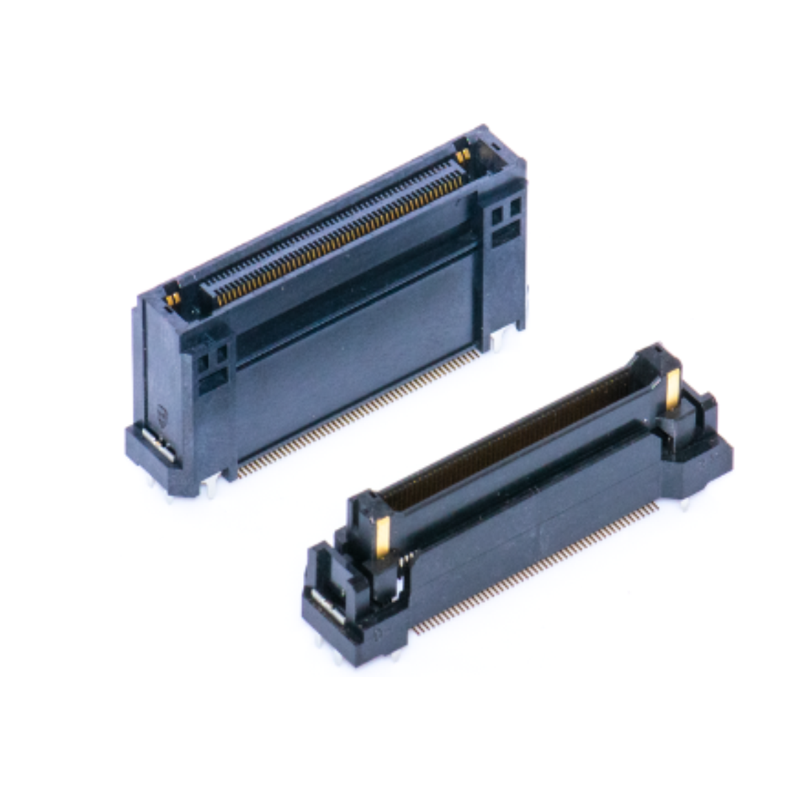
One of the advantages of a floating board-to-board connector is that it can withstand large loads. Because there is a certain gap between the connectors, the pressure can be effectively dispersed, thus avoiding the occurrence of stress concentration. In addition, the flexibility of this structure makes it able to adapt to a variety of different application scenarios and requirements changes are also improved. For example, when an assembly or disassembly operation is required, a floating board-to-board connector can be achieved by adjusting the relative position of the two boards.
Another important feature is that floating board-to-board connectors are more reliable than traditional welded or threaded connections. Because of the existence of the gap between the connecting parts, the connection part is not vulnerable to corrosion and wear and failure. At the same time, the floating board-to-board connector also has good vibration resistance and can maintain stability in the environment of high-frequency vibration. This is especially important for some equipment that needs to operate in a vibration environment
However, floating board-to-board connectors also have some disadvantages. First of all, this connection requires a precise design and manufacturing process to ensure the quality of its connection. Secondly, due to the large gap between the connectors, it may lead to problems such as water leakage and leakage. Finally, floating board-to-board connectors are usually suitable for small or simple connection occasions, and may not be suitable for large complex structure connections.
In summary, the floating board-to-board connector is a very practical mechanical structure that enables reliable connections on surfaces of different shapes. Although it also has some shortcomings, but with the continuous progress and development of technology, I believe that these problems will be better solved.