

The components of the board-to-board connector are mainly composed of two parts: the female connector and the male connector. Usually, the female connector is fixed to the board and the male connector is plugged into the female connector. Both the female and male headers contain metal contacts, and the male headers are plugged in and out of the female headers. They are connected to each other through channels, and also allow for circuit board wiring and the transmission of signals and power between various parts of the board.Board To Board Connector
Board-to-board connectors vary in shape and performance characteristics. According to the use of the occasion and requirements, board-to-board connectors can be divided into the following categories:Slot Connector
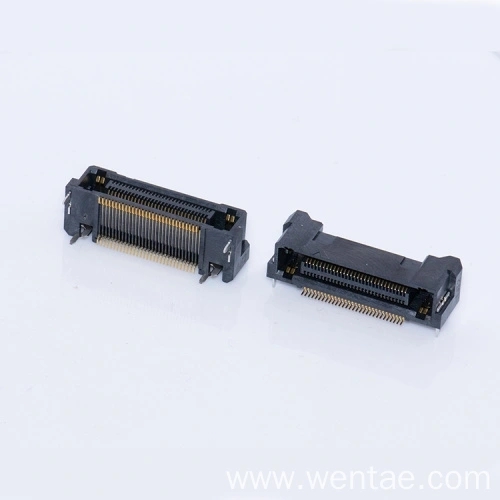
Direct plug-in board-to-board connectors: the use of pins into the female chassis, through the snap to achieve fixed. This connector is easy to plug and unplug, and can be reused many times.
Offset board-to-board connectors: different from the straight board-to-board connectors, inserted into the female chassis to tilt a certain angle, and then turn right after the engagement, through the snap to achieve fixed. This type of connector can be plugged and replaced without disassembling other devices, providing greater flexibility.
Resilient contact board-to-board connectors: Resilient contact tabs are used instead of pins to insert into the female chassis, and are fixed by snaps. This connector can achieve successful docking in the case of inaccurate docking direction, while reducing the vibration caused by the docking and maintaining a stable connection, with a long service life.
Face-to-board connectors: the use of metal or flexible materials directly with the board in the form of welding to achieve docking, no need for pins or other reinforcement mechanisms, space-saving, simple installation, but the plugging process is more difficult.
No matter what kind of board-to-board connectors, its environmental performance has also become an important consideration. Some national and international environmental regulations on the production and sale of electronic products are higher requirements, board-to-board connector materials, structures and production processes are constantly being optimized and upgraded to meet the increasingly stringent environmental requirements at the same time, to better adapt to market demand.