

Board-to-board connector wiring method: first of all, the solder wire wrapped around the support bar with a diameter comparable to the long lead pin of the board-to-board connector, followed by cutting the solder wire on the support, to be cut on one side of the solder wire is complete. One or more flattened solder rings are placed on the bottom of the long pins of the connector and then heated by blowing hot air into the connector, which melts the rings and brings them between the PCB board and the long pins of the connector. When the solder ring is completely melted, stop blowing hot air into it and wait for it to cool down naturally, then the solidified solder ring will connect the connector long pins to the PCB board.
Board-to-board connector applications
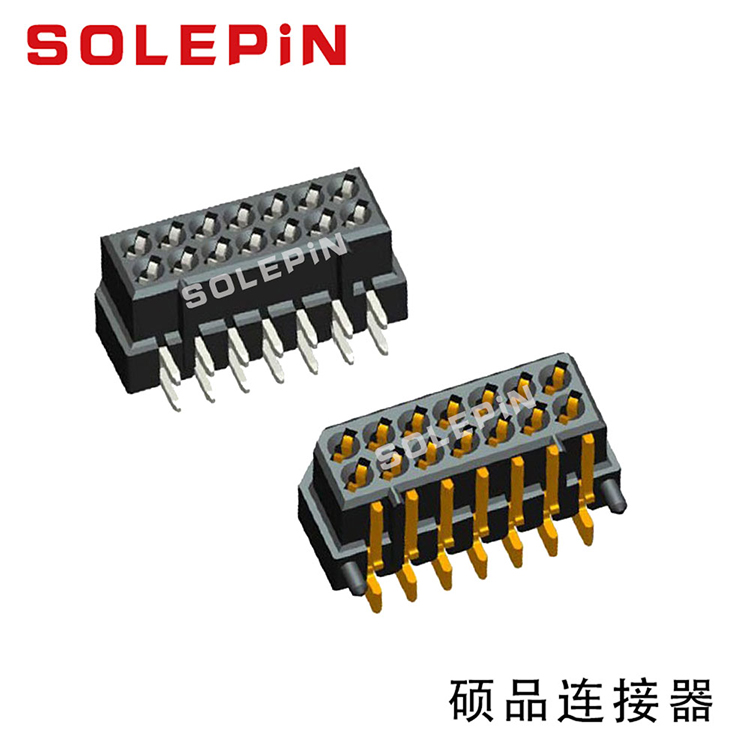
In electronics manufacturing the entire device may need to fit into the available space, as the device may be split into two or more boards if the PCB at the board design stage tends to take up too much space. Board-to-board connectors can connect power and signals between boards to make all the connections. Board-to-board connectors can simplify the board design process. Smaller PCBs often require manufacturing equipment that cannot accommodate larger PCBs, whether the device is squeezed into a single PCB or multiple PCBs, power consumption needs to be considered.
In addition, the use of board-to-board connectors also simplifies the production and testing of electronic devices. Simplifying testing in electronics manufacturing reflects significant cost savings. High-density PCBs have more traces and components per unit area, and devices or products are best designed with several interconnected medium-density boards rather than a single high-density board.
This article can only lead you to the board-to-board connector structure principles and connection methods have a preliminary understanding of the hope that you will have some help, while the need to constantly summarize, so as to improve professional skills, but also welcome you to discuss some of the article's knowledge points.